SnowPod and the Real Cost of Desktop Metal 3D Printing
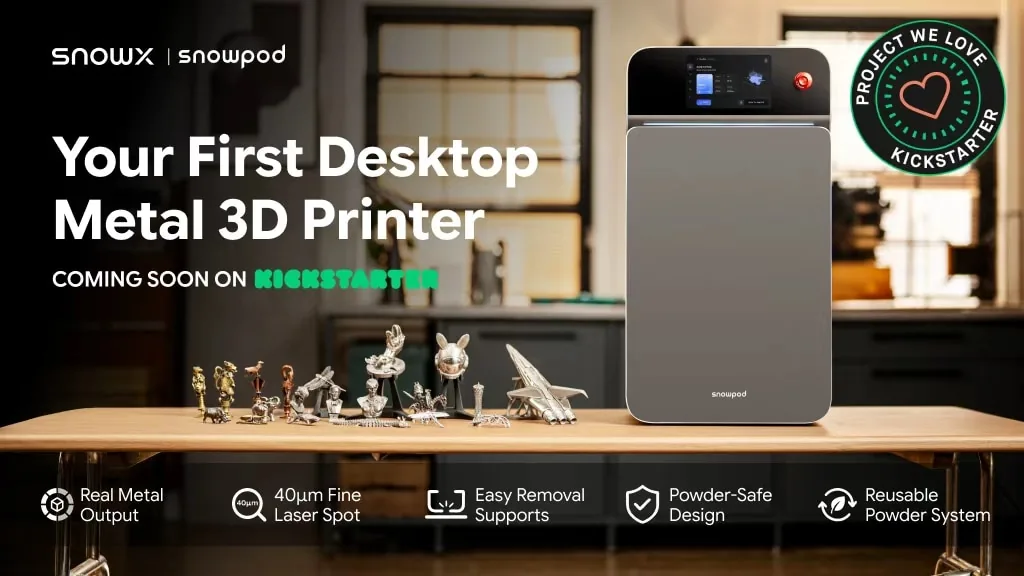
A metal 3D printer advertised at $4,999 changes the buying conversation. It does not, by itself, change the economics of making a usable metal part. That distinction is the most interesting part of SnowPod’s Kickstarter buildup. SnowX is pitching a compact laser powder bed fusion system that combines printing, powder handling and recovery in a desktop enclosure. Its opportunity is to make small metal parts easier to produce in-house, not simply to fit a laser onto a smaller machine.
For a product-development studio, a jewelry workshop or a small engineering business, the appeal is easy to understand: fewer external handoffs and more control over iteration. Whether that becomes a practical advantage depends on the work surrounding each print, from preparing the powder to checking the finished part.
Industry analysis · Sources checked October 28, 2026. This article draws on SnowX’s published specifications, its reservation terms, the Kickstarter prelaunch page and attributed industry reporting. Gadgets3DP has not tested SnowPod or independently verified its performance claims.
Cover: SnowX’s Kickstarter promotional image. Displayed objects and marketing statements are manufacturer material, not Gadgets3DP test results.
First, SnowPod is still preparing to launch
When checked on October 28, the SnowPod Kickstarter page said “Launching soon” and offered “Notify me on launch.” It displayed 1,370 followers. Those are people following a prelaunch project, not 1,370 paid backers, and the page did not present a live funding total or open reward tiers.
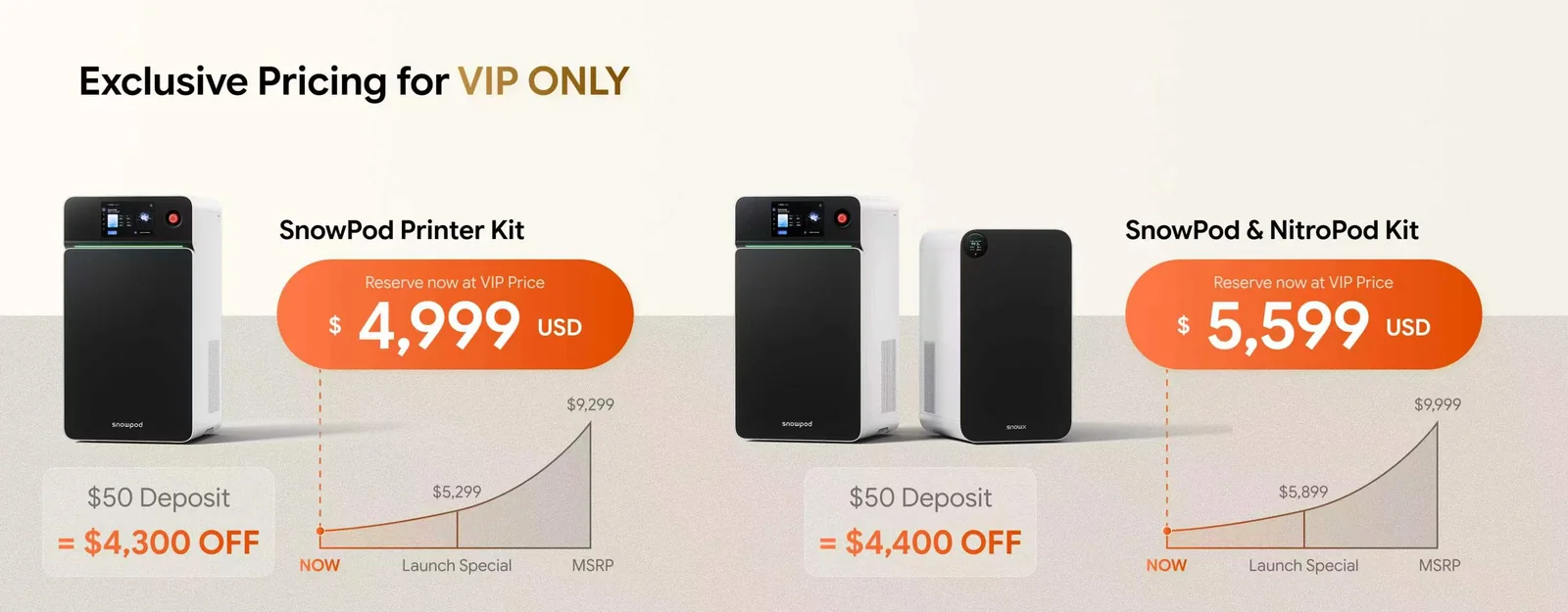
SnowX does have a separate $50 VIP reservation page. Its advertised pricing separates the printer from the version bundled with NitroPod, the company’s nitrogen generator:
| Package | Advertised VIP price | Advertised launch special | Stated MSRP |
|---|---|---|---|
| SnowPod Printer Kit | US$4,999 | US$5,299 | US$9,299 |
| SnowPod + NitroPod Kit | US$5,599 | US$5,899 | US$9,999 |
These are prelaunch advertised prices, not verified delivered totals. SnowX’s FAQ says the $50 deposit is refunded to the original payment method and the additional $300 VIP discount is applied within 14 days after the Kickstarter campaign ends. It also says customers who decide not to back can request a refund before launch. The $300 advantage is already reflected in the VIP figures above; subtracting it again would double-count the discount.
The gap between VIP and launch-special pricing is therefore $300, while the larger savings in the artwork are comparisons with SnowX’s stated future MSRP. Confirm the final pledge process, shipping, taxes, included accessories and refund terms before treating either figure as an installed-system budget.
The shift is from a compact machine to an integrated process
SnowPod uses selective laser melting, commonly discussed within laser powder bed fusion, or LPBF. A laser selectively melts metal powder layer by layer. Its initial supported material is 316L stainless steel, according to SnowX’s official specifications. This is different from metal-filled decorative filament and from bound-metal extrusion, where a printed binder-and-metal part subsequently needs debinding and sintering.
That distinction matters commercially. Different metal additive manufacturing processes create different equipment needs and finishing steps. A prospective buyer should compare the full route to an acceptable part, not group every process under the same “metal 3D printer” label.
In an October 22 3Dnatives account of SnowX’s development process, founder Fangda Xu described an earlier wire-fed laser deposition machine whose parts required so much additional work that the team reconsidered the approach. The report presents the company’s history and reasoning; it is not an independent production benchmark.
It nevertheless identifies the right commercial problem. If a small shop prints a metal blank and then has to send it elsewhere for most of the work, ownership may offer little advantage over sending the original CAD file to a service bureau. SnowPod’s sealed powder cartridges, recovery system and removable supports are attempts to reduce those handoffs.
An 80 mm build plate can be a focused niche
The published build volume is 80 × 80 × 100 mm, approximately 3.15 × 3.15 × 3.94 inches. That rules out plenty of larger jobs, but it also defines a plausible customer: someone making compact, relatively valuable components, detailed metal objects or repeated design iterations.
Consider a small development team evaluating a metal housing with internal features, or a designer refining a short run of ornamental components. The attraction could be a shorter feedback loop, especially if the part is awkward to machine. The value comes from the application and the avoided delay, not from the fact that a part is metal.
A simple bracket with accessible flat surfaces may still be easier to buy or machine. A large part will not become a sensible SnowPod job just because it can be split into sections. Orientation, supports and removal access also reduce the usable space inside the nominal envelope.
For the industry, this suggests a more credible early market than universal home manufacturing: compact metal printing as a specialized workshop tool. That is an opportunity worth examining, even if it remains narrower than the product’s desktop imagery implies.
Fine details and finished-part quality are different promises
SnowX lists a 200 W fiber laser, an approximately 40 μm laser spot and layers from 30 to 60 μm. These numbers describe parts of the printing process. They do not establish the dimensional tolerance, surface finish or mechanical properties of every finished object.
The company’s 0.05 mm dimensional-accuracy claim has a particularly important qualification: its website ties the figure to internal testing of a 12 × 12 × 12 mm lattice. SnowX says results vary with geometry, dimensions and printing conditions. A small test lattice is not enough evidence to promise the same tolerance on a thin wall, a mating surface or a part spanning most of the build plate.
The gallery also states that displayed parts have been post-processed for presentation. That makes the images useful examples of possible finished objects, but a poor basis for estimating how a raw print will look or how long finishing will take.
Buyers should ask for paired as-built and finished samples, the documented finishing steps, and measurements on geometry relevant to their work. For load-bearing applications, dimensional accuracy alone is not sufficient: material properties, defects and process repeatability matter too.
Powder cartridges could reduce labor, while creating a new dependency
SnowPod’s proposed cartridge workflow combines powder supply, containment and recovery. If it reduces routine pouring, sieving and cleanup, that could be a substantial usability improvement for a small operation. Labor saved between builds can matter as much as the minutes spent scanning a layer.
The recurring-cost questions are less visible in a launch image. What does a replacement cartridge cost? How much powder is usable after repeated cycles? What happens when the material changes condition, or a filter needs replacement? Can approved consumables be obtained locally without a long interruption?
SnowX advertises more than 90% powder recovery under laboratory conditions. Recovery is not the same as an unlimited reuse allowance, nor does it establish the cost per accepted part. Powder incorporated into supports, failed builds, contamination and maintenance still affect the result.
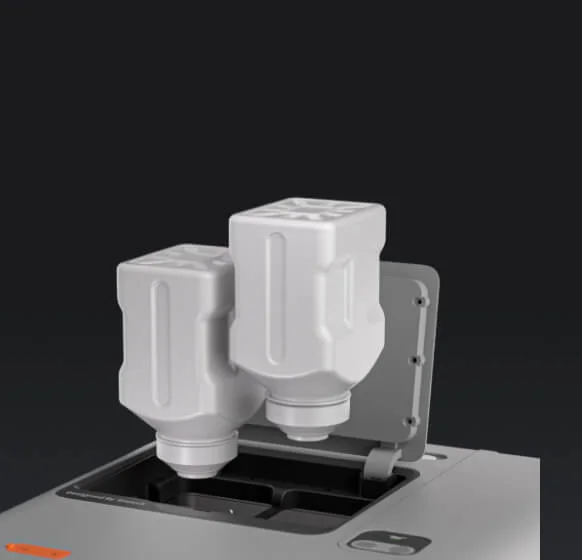
That creates a broader industry tradeoff. An integrated material system can make operation easier and process settings more consistent. It also makes the supplier’s consumable pricing, support and continuity part of the ownership decision. Hardware affordability and a healthy consumables ecosystem need to develop together.
Nitrogen and filtration belong in the ownership calculation
The NitroPod bundle makes the system boundary clearer. SnowX specifies nitrogen as the shielding gas and advertises NitroPod at 99.9% purity with a 3 L/min flow rate. The generator is intended to supply the printing atmosphere; its specifications do not verify the oxygen level maintained during every build.
Similarly, an H14 filter rating is not a complete workplace-safety assessment. SnowX explains that its 99.995% figure refers to the EN 1822 efficiency requirement for H14 filter elements. That does not, by itself, measure exposure during cartridge changes, servicing, spills or other maintenance tasks.
The company’s FAQ recommends PPE during normal operation and requires it during maintenance or servicing. Buyers should obtain installation instructions, the powder safety data sheet, gas and ventilation requirements, and filter-handling procedures before choosing a location. OSHA’s combustible-dust guidance provides general context about finely divided materials, including some metals; it is not a finding about SnowPod.
For a business, “desktop” is a footprint description. The 40 kg machine, gas equipment, working clearances and maintenance arrangement all need space. A suitable installation must be assessed as a system rather than inferred from a promotional photo beside a computer.
The useful metric is cost per accepted part
A purchase-price comparison is only the beginning. A more useful model is:
Cost per accepted part = total costs allocated to a defined period ÷ accepted finished parts produced in that period.
Count equipment allocation, powder, gas, electricity, replacement consumables, maintenance, labor, finishing and inspection. Include resources used by failed attempts once within those categories, rather than adding the same costs again as a separate scrap charge.
Here is a simple illustration using only the advertised US$5,599 SnowPod + NitroPod VIP price. It is an allocation exercise, not a forecast of actual manufacturing cost:
| Accepted parts over the chosen ownership period | Equipment-price allocation per part |
|---|---|
| 20 | $279.95 |
| 100 | $55.99 |
| 500 | $11.20 |
Every operating cost in the formula remains additional. The example also assumes the advertised bundle price is paid, excludes financing and residual value, and says nothing about achievable throughput. Its purpose is to show why utilization and yield can outweigh an attractive launch discount.
For a shop making occasional metal prototypes, outsourcing may still offer better economics and access to more materials. For a team repeatedly waiting on small, similar parts, in-house iteration may be valuable even without the lowest unit cost. Compare quotes for your own representative part, including finishing and inspection, against a measured internal workflow.
What would make this a meaningful industry milestone?
A successful campaign would establish willingness to fund the project. Delivery would establish that SnowX can manufacture and distribute it. Neither milestone alone would demonstrate repeatable production economics.
The stronger evidence would arrive after users can document multiple builds: finished dimensions, material consistency, actual operator time, consumable replacement intervals and the percentage of parts that meet their requirements. A repeatable job on a customer's bench would be more informative than another isolated showcase print.
SnowPod’s public materials also discuss AI-assisted model analysis. The Kickstarter description frames this as a planned capability for identifying printability issues and guiding preparation. It should be evaluated as a software promise, not as an already validated substitute for metal-printing expertise.
The opportunity is real enough to take seriously: a smaller, more integrated LPBF workflow could let more workshops experiment with metal parts. The question is whether SnowX can make the entire process predictable enough to use repeatedly. That is where affordable desktop metal 3D printing would become more than an affordable machine.
For the specification-focused companion piece, see our SnowPod desktop metal 3D printer overview. Follow the official Kickstarter project for the eventual launch terms and delivery schedule.
Sources and editorial method
- SnowX’s Kickstarter prelaunch page: current project stage, follower count and planned AI functionality.
- SnowX’s official specifications and VIP reservation page: process, material, published limitations and advertised price/discount mechanics.
- 3Dnatives, October 22, 2026: attributed account of the company’s development choices and pricing context.
- OSHA: general combustible-dust background, not product certification.
All linked sources were checked for this analysis on October 28, 2026. Commercial interpretation and the allocation example are Gadgets3DP’s analysis. Manufacturer claims are not presented as independent tests. Images are SnowX promotional material; final production details may change.